In the 1980s, scientists discovered a dramatic decline in stratospheric ozone concentrations over Antarctica, leading to what became known as the “ozone hole”. This anthropogenic environmental crisis catalyzed the adoption of the 1987 Montreal Protocol, initiating a global phase-out of ozone-depleting substances such as chlorofluorocarbons. Over the nearly four decades since, Antarctic stratospheric ozone has entered a period of gradual recovery. However, whether the austral summer Southern Hemisphere atmospheric circulation changes that emerged during the ozone depletion era have begun to weaken with ozone recovery, and whether such a reversal is spatially uniform, remain key open questions. Addressing these issues is crucial for understanding Southern Hemisphere climate trends and represents a central challenge in current polar climate projections.
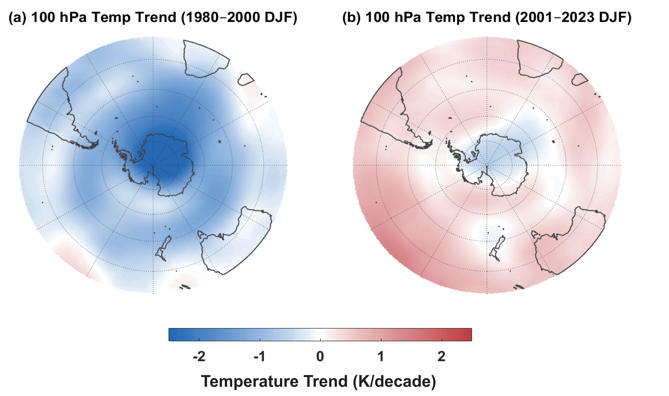
Trends in lower stratospheric temperature. (a) 1980–2000 and (b) 2001–2023. Credit by Hanyue Zhang.
Recently, Professor Fei Zheng from the School of Atmospheric Sciences at Sun Yat sen University, China, together with her master student Hanyue Zhang and co workers, used ERA5 and JRA-55 reanalysis datasets to systematically compare the evolution of atmospheric circulation during the ozone depletion (1980–2000) and ozone recovery periods (2001–2023). These results have been published in Atmospheric and Oceanic Science Letters.
The results demonstrate that the austral summer Southern Hemisphere circulation exhibits contrasting evolutionary characteristics across the two periods. During the ozone depletion period, marked stratospheric cooling over Antarctica sustained a significant strengthening trend in the Southern Annular Mode (SAM), the dominant mode of variability in Southern Hemisphere extratropical atmospheric circulation, accompanied by a continuous poleward displacement and intensification of the mid-to-high latitudes westerly jet. With the onset of ozone recovery, gradual Antarctic stratospheric warming coincided with a distinct change in circulation trends: the positive SAM trend slowed substantially, and the poleward migration of the westerly jet weakened. Notably, this trend slowdown was not spatially uniform around the Southern Hemisphere, with the signal being most pronounced over the South Pacific sector. Rolling trend analyses further confirm the persistence and robustness of this circulation trend deceleration. Because changes in the austral summer Southern Hemisphere circulation are closely linked to Antarctic sea-ice distribution, Southern Ocean carbon uptake, and regional precipitation and temperature patterns across the Southern Hemisphere, understanding circulation evolution under ozone recovery is critical for projecting future climate trends.
“Although previous studies have provided initial insights, the long-term dynamics of austral summer Southern Hemisphere circulation trends during the ozone recovery phase remain insufficiently understood. While existing literature notes a pause in Southern Hemisphere circulation trends through 2017, whether this pause has persisted into the most recent years remains an open question. To address this, we built upon prior research by extending our analysis period through 2023 and applying a suite of statistical techniques to compare Southern Hemisphere circulation changes between the two stages, thereby further clarifying the spatial features and persistence of this trend transition,” says the corresponding author Professor Fei Zheng. “These findings deepen our understanding of how Southern Hemisphere atmospheric circulation responds to ozone recovery, offering valuable insights into the competing influences of ozone recovery and greenhouse gas forcing on Southern Hemisphere extratropical circulation trends.”
Building on these findings, the research group will next evaluate how well state-of-the-art climate models represent Southern Hemisphere mid-to-high latitudes atmospheric responses to Antarctic ozone recovery, and examine model biases in simulating the interactions between stratospheric ozone and large scale tropospheric circulation. These evaluations are expected to provide a basis for improving future climate projections over the Southern Hemisphere.
Citation:
Hanyue Zhang, Fei Zheng, Rui Wang, 2026. Contrasting austral summer Southern Hemisphere circulation trends before and after the recovery of Antarctic stratospheric ozone. Atmospheric and Oceanic Science Letters, https://doi.org/10.1016/j.aosl.2026.100867.
|







 Editor's choices & News